How Grandfather invented windowscaping, or, every room needs a beautiful view

My grandmother’s health took a downturn when she was in her forties, and the doctor ordered her to bed for almost six months. Dear Grandfather was beside himself. My mother took over many of the household duties and swore that was why she was such a good cook. But my poor grandfather felt helpless.
“What can I do?” he would plead, but there seemed to be nothing to do but what he was already doing.
Then one day he had an idea.
My mother was looking out the back door when Grandfather creaked open the metal arched gate to the back yard with a gorgeous pale yellow jasmine plant in his arms.
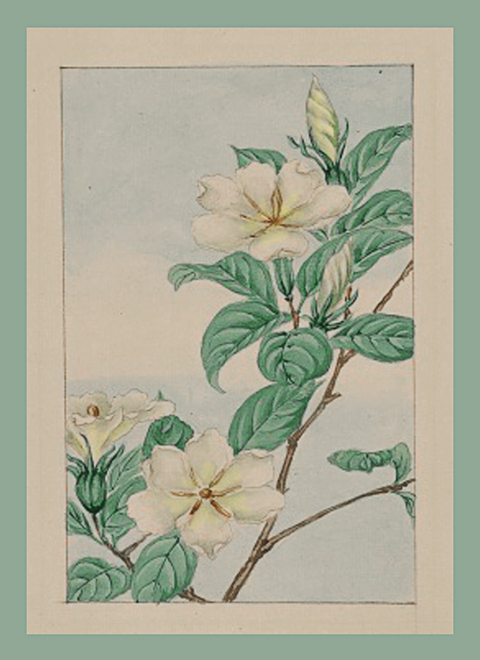
“Where’re you gonna put it?” My mother asked.

“Outside your mother’s window, so she can smell it all day long.”

He placed it just so, asking Grandmother if she could see it better here or there – sort of like an optometrist appointment. And after a half hour’s work and many anguished questions through the screen from my grandmother, the jasmine stood tall, proud, staked and fertilized just outside her window. She enjoyed the scent that came in on the breeze and the beautiful blossoms. Grandmother always swore it helped her recover.

This success went to my grandfather’s head. He had discovered a way to satisfy a very basic human need – the need for beauty. He was on a roll. Every bedroom – all two of them – had to have something sweet-smelling outside the windows. For my mother and father’s room, it was honeysuckle. What heaven! Then he attacked every other window in our little house, digging and planting and rearranging and paying visits to the neighbors to see if they would mind letting him have a cutting from an admired plant. He became a regular at the nursery. If “frequent shopper” rewards had existed back then, he would have been able to buy a new car.

He moved past the search for intoxicating scents and on to the aesthetics of gardening. Every window smelled good; now it had to have a beautiful view. More huffing and puffing and planting ensued. When my grandmother was up and around again, she decided that what was inside could help what was outside. To accent the yellow-blooming jasmine, she brought in yellow and white flowers with a long trail of ivy and put them in a milk-glass vase by the window to tie the two together.

Blue hydrangea #flowers #hydrangea #blooms #blossoms #flowers #gardening

Image “Blue Hydrangea” courtesy of panuruangjan at FreeDigitalPhotos.net

Under the front windows was a stand of hydrangea. These she doctored with vinegar or lime to change the acidity of the soil and thereby the color of the blooms. As time went on, she had a multicolored group of the loveliest flowers in the neighborhood. And she could enjoy them from the kitchen window.

Their philosophy of gardening and decorating hinged on a deep-rooted love of nature that came from living in quiet country places blessed with lush vegetation, fresh air and abundant wildlife. Growing up in a naturally beautiful environment gave them sights into beauty that otherwise could take many years to learn.

I still think of my childhood home and the example set for me there, and at my own home there is something I love to see outside every window but one.

I’m working on it….


Modern methods of changing hydrangea color can be found at Gardenista.

Better Homes and Gardens has lovely ideas for planting window boxes.

Southern Living has a great list of the best spring flowers to plant.

For windowsill gardens, Better Homes and Gardens has good ideas on that, too.

For color theory in flower gardening, take a peek at House and Garden Television.

Text copyright ©Jill Teresa Farmer, 2015
Hemingway versus the spider – Writing 101, Day 17

The pretty little waitress told him it was there in the bar. A big one. Black. Maybe the hourglass. A black widow.

He hitched up his pants. “I’ll take care of it.” He put his Jose Cuervo down with a solid thud.

“You want a flyswatter?” She looked all woman in that little short dress and tiny apron. It had a ruffle around it. “Drink Up” was the name of the bar. It was stenciled on the back of her shirt.

“I don’t need a flyswatter.” He stood up. “Where is it?”

“Under the last table, in the corner back there.” She pointed. She needed a manicure.

He wondered how he would do it. Just stomp on it? What if it jumped? But it probably wouldn’t.

The corner table was like all the others. Sticky with the remains of the croissant someone had brought over from the bakery next door. He almost turned away. No real man ate croissants. He leaned over and looked under the table. Nothing.

“You sure it was here?”

Her face was pale. “I know it was. I saw it.”

“Where exactly?” He pulled out a chair to get a better look.

“Right about where you’re looking.”

“I don’t see it.”

“It’s there.”

He wasn’t about to admit he needed glasses. He squinted. “How big did you say?”

“Couple of inches.”

“Would that be including the legs?”

“Yeah. Including the legs.”

He still didn’t see anything. She was probably pulling the helpless female thing to get his attention. It had happened before. During the war. Back in Paris….

“Are you going to just look?” she asked. Exasperation edged her voice.

“Reconnaissance is a big part of any battle. General Patton -”

She jumped back. A trembling finger pointed. That chipped polish again.

He grimaced. “Now what?”

“It’s there, right there.”

“Where?”

“RIGHT BY YOUR FOOT!”

He jumped. It wasn’t because of the spider. She had the voice of a trumpeting water buffalo.

“Dang, woman – I’m not deaf.” He stared all around his feet. Nothing.

A little man came out of the kitchen. A thin man. Small, insignificant. A white towel was tucked into his pants front like a surrender flag. A man who’d obviously never seen action. Probably ate croissants. He stared at them. “What’s going on?”

“It’s a black widow. Right there by his foot,” the girl said. She backed up. Now she was behind the little man with the towel around his waist.

“That could be a Steatoda grossa,” the little man said.

“A what?” He wished this clown would just go back in his kitchen and cut himself on the can opener.

“A false black widow. They can look black in some light, but -”

She shrieked. “It’s going up his pants leg!”

“What!” He jumped and fanned his hand at the general area she was pointing to. Now he was actually feeling something. A crawling sensation. It was there. It looked black to him. He could just make it out, advancing upward. Shiny. Stealthy. Brave. Coming in for the kill.

“Get this thing off of me!” he screamed.

The little man twitched the towel from his belt and snapped it at the spider.

They fell together, man and arachnid.

She knelt beside him. His head was now cradled in her arms. She patted his cheeks. “He’s fainted.”

The small man picked up the limp spider with a swizzle stick. “No, it was the real thing. Black widow. I’ll put it down the disposal.”

The girl looked down into his face. He was beginning to come to. “You okay?”

“Is it – ” he asked.

“Dead and gone. It’s okay now.”  She was watching the color come back into his face. “Can you get up now?”

“Sure.” He managed to get up, trying hard not to let her see that he was hanging on to the table. She clung to his arm, just in case.

“It was a flashback. Anzio. I was there again. Back on the beach. It happens to a lot of us.” He settled hard into a chair. He wondered exactly where Anzio was.

The little man came back from the kitchen with a hot croissant and set it in front of him. “On the house. I got it from next door. You want something on it?”

“Got any strawberry jam?”

He couldn’t help it. He loved croissants.

How to hang out the wash without disturbing the birds, or, Lessons from a wonderful neighbor

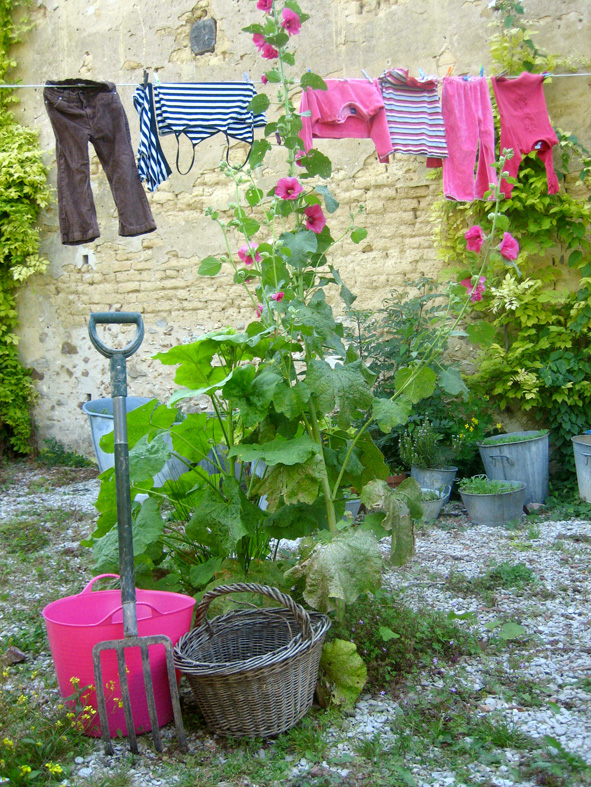
I had always helped my mother and grandmother hang out the wash. By “help” I mean handing them the clothespins and singing “Bringing in the Sheets”, my mistaken rendition of the old hymn “Bringing in the Sheeves”. At least I was on key. How fresh everything smelled from clean country air!

I loved this small chore so much that I farmed myself out to help the neighbors. Across the street lived Mrs. Johnson. Having a grown son who lived in another town made her a bit lonely for small companionship, so she happily accepted my “assistance”.

Hers was one of those old clotheslines made up of a “T” of hollow metal tubes. But it wasn’t as drab as it sounds, as a beautiful yellow-blooming vine twined across one end. It was probably that vine that drew other lodgers to the clothesline. Every year a bird would build a nest in one arm of that end post, lay her eggs, and go through all the avian motions of raising a tiny family.

Now there is one hitch to all this: birds are easily disturbed by humans, especially mother birds. And we needed that clothesline. But Mrs. Johnson was a nature lover like the rest of us, and she knew the difficulties all new mothers face. So we started hanging out the wash – in the house. We draped towels and clothes over every available waterproof surface. But that still left the sheets. Where on earth would we put those?

We would have made any onlooker very curious. First Mrs. Johnson would take a delicate pinch of snuff to steel her nerves. Then we would peer around the back screen door. Was she home? We would hold our breath – did you hear a chirp? Was that a flutter at that end of the clothesline? Maybe we can’t see her for the vine. Better stand here a minute to be sure.

Once we were convinced she was away from home, we would tiptoe out and hang out the wash in mute silence, using hand signals for “another pin, please”, and the frantic one for “Here she comes – get back in the house!” We used only the end of the clothesline farthest from the birds, and many a sheet that would have dried wrinkle-free was ironed because it had to be scrunched up to fit on a tiny section away from the little nursery.

Afterward we would sit on the screened-in back porch in happy satisfaction, sipping ice tea with plenty of sugar. As the days went by, we were treated to a view of nest material hanging out of the pole, small eggs, the sound of little cheeps, then a tiny beak or two. Then flying lessons. Then, the big day – the little family would be raised and the nest deserted.

Despite the strain it had been on our nerves, it was always sad when the abandoned nest held no more life. We would change back into our off-season routine. No more wet clothes over the back of the Johnson kitchen chairs. Everything could go right out on the line. We could laugh and sing as we worked our way down to the end of the old rope.

But at the end of every laundry session, Mrs. Johnson would cast a wistful eye at the end of the clothesline. I knew what she was thinking, for I was thinking the same: “I hope they’re happy, wherever they are.”

From Mrs. Johnson and the wonderful women like her, I learned reverence for all God’s creation, and that chores shared with those you love are not really chores at all. She taught me that we can all peacefully coexist with just a few concessions, seeing things from the other’s point of view, a lot of consideration for others, and, if necessary, a pinch of snuff.


Text copyright © Jill Teresa Farmer 2015. All rights reserved.


The names in this true story were changed to protect privacy. And it’s a shame – “Mrs. Johnson” was a lovely lady and a real character. I was privileged to have her in my life.

Writing 101, Day 14: An open letter to Prestige

My dear esteemed Prestige:

Excuse me for beginning this letter in such familiar terms. I would imagine that you would prefer to be addressed as “Your Excellency”, “Your Highness”, or something else equally ego-satisfying. You may not remember me, but we met on page 361 of In Search of Lost Time by Marcel Proust, Volume 5, “The Captive”. You are a truly interesting word, I must admit. I googled your definition for the sake of exactness and came up with this: “widespread respect and admiration felt for someone or something on the basis of a perception of their achievements or quality.” And therein lies the rub.

It is, if you will pardon me for saying so, that little word “perception” that bothers me so much. “Perception” is relative in its meaning. I suppose this makes sense. Little children often feel that some character on television has great prestige by virtue of some completely imaginary superpower; grown-ups attribute prestige to those who have achieved great wealth through their own efforts, such as Bill Gates, or great notoriety, such as Paris Hilton. And this is what bothers me.

I really prefer things to be a little more precise than what you seem to be. After all, what is prestigious one day is quite old-fashioned and comical the next. So, if you will excuse the question, “What good are you, anyway?” Your definition is so slippery and fickle that I’m not quite sure I have much respect for you anymore. Nowadays when I hear you used, you are almost always followed by “university”: This or that institution is a “prestigious university”.

It must annoy you to know that you have been largely replaced by the phrase “trending now”. I’m sorry for this; that’s a rather clunky term and you are a truly musical word when pronounced correctly. So please hang in there. You may not be trending now, but I think you will come back. And not just because they built another university. But if worst does comes to worst, just remember that once upon a time you were a word used by Marcel Proust in one of the most brilliant novels ever written. That amount of prestige ought to be enough to set you up for life.

Well, I won’t take up any more of your time. You probably won’t hear from me again, as you keep changing addresses. Have a good life and take care of yourself.

With great respect,

An anonymous admirer

Happy family reunion, or, how to get in trouble without really trying

Little girl with a pan of corn #children #corn #summer #girls

A family reunion and a platter of corn on the cob earned me a reputation as a terrible dinner guest. Maybe I was, but in my defense I was only three or four years old at the time and my social graces were limited. Nevertheless, you would have thought I’d managed to violate every code of Southern honor and Emily Post rule of etiquette that ever existed. But maybe I’d better tell you what happened. Continue reading

Writing 101: Day 8, no adverbs – An ice cream sundae in the park

The park is as it has been for one hundred years, give or take a water fountain or two. The trees bend leaf-laden arms overhead until they touch, their pale green tips entangling and clinging to one another.
The wooden slatted benches are more comfortable than the modern “improvements” they replaced – those hard, flattened arches of concrete that were touted as an “evolution” in design. Alas, our sitting apparatus had never evolved, and one noisy night a local college group demolished them with a great clamor and a final cheer. We were all grateful.
I think of that now as I chase the little rivulet of ice cream that’s creeping down my chin. The napkin catches it. I had coveted that voluptuous banana split that Louise had touted, telling me in graphic detail of its delicious perfection, the superiority of the whipped cream (“Real cream – none of that plastic stuff”), and the gleaming roundness of that perfect red maraschino cherry that dazzled from the snowy summit. I had wavered, but told her in an unconvincing voice that all I really wanted was a small chocolate sundae. She had snorted, but plopped an extra cherry on top all the same.
The sun is warm but not yet burning, and it seems that everyone else in town has decided that lunch in the park is a good idea. From the squirrel that snuffles and grunts and swishes its feather-duster tail, to Mr. Parker who has deserted the bank, loosened his tie, and slipped his feet halfway out of his impeccable Florsheims, to the young mothers in pastel shorts who lean their heads together and giggle and then make patting gestures in the air as they describe curing infant fussiness.
But there are few of the mainstays of the town – the solid working men who populate the box factory and the fields. It would be too far a trek in heavy boots and sweat-stained overalls. And it would take time, time they could use to tell embellished tales of weekend fishing trips, arms waving in the air to measure their catch, voices raised and excited over the rainbow trout that got away. They will be lolling against the tree trunks, bone-weary, enjoying the company of their coworkers and friends who chomp on everything from biscuits and jelly to the remains of last night’s now-rubbery chicken fried steak.
Dabbing at my sticky chin, I deliberate whether to arc the empty container into the trash from here. But no, my images of a graceful, Whitey Ford throw usually culminate in splattered wreckage on the grass. Besides, Mr. Parker has his eyes closed now, and there is a possibility he will nod off. A poor throw could make a harsh bounce off the metal and startle everyone.
The chimes from the church bell tower begin, and I know it’s time to go. I see Mr. Parker jerk into full consciousness. Perhaps I could make that throw. When it seems no one is looking, I lift my arm and let it fly. It takes forever before it hits the back of the trash can, hesitates, and then slides inside, a trail of melting ice cream on the plastic liner the only evidence.
“Yes!” I think.
A small victory on a perfect day.

Writing 101: Day Six, Character-Building

I ran into Kerry for the first time in ten years. I remembered her from  high school, but all she cared about then was cheerleading and getting married. The last time I saw her she had been headed for college to get a degree in elementary education. Somewhere between her freshman and sophomore years her vivacious personality and toothpaste-ad beauty had snared her the sought-for husband. Soon I began to receive monthly updates of letters spilling over with baby pictures. Nothing very personal was ever said, just reports on how the baby was doing and how happy she was. I moved away and we lost track of each other. Since she hadn’t really penetrated my consciousness very much, I gave her little thought in the intervening years.

But seeing her this Tuesday was a shock. It was as if all the light had drained from her eyes and something had pricked the balloon of her personality until it lay on the restaurant table between us, flat and deflated. Everything irritated her: the service, the menu, the voices of the other patrons, the fact that I was wearing a color she didn’t approve of. I was trying to think of excuses to leave before the meal arrived, but none came. I was only half listening when the giveaway sentence fell like lead between us. “And then after the divorce –” What? What divorce? I had long ceased receiving updates on her idyllic life. I had no idea.

“You just don’t get it, do you?” she smirked. “The majority of people in this country who get married get divorced. So what’s the big deal?”

I mumbled something about not knowing about the divorce and was trying to think of some way to change the subject. This definitely qualified as an awkward moment.

“Come to think of it,” I said. “I only know of one girl who is still married from high school. You remember Carol?”

“Carol just trapped him into marriage. If anybody should be divorced, she should.” There was a biting meanness in that remark that left me speechless. She tapped her fork on an invisible spot about three inches in front of my nose. “And don’t try to pretend you’re happy. I know better.You were the one who was supposed to go on to college and get that big-shot degree. Didn’t happen, did it? I heard you ran out of money right before your junior year. Husband didn’t make enough money, did he? And your parents didn’t chip in either, did they? They didn’t care, did they? That makes you a failure, too. Don’t pretend you’re not. What a joke. Life is just a joke.”

That gesture with the fork had frightened me. Its resemblance to a pitchfork was a little too much for this country girl. “Maybe we shouldn’t be having this conversation,” I said shakily.

“Ha! I got you there, didn’t I? I hit a nerve!” she crowed. “So now you want out of the whole conversation. You don’t want to talk. Miss Fancy Pants doesn’t want to talk.”

I was beginning to want a pitchfork of my own. “Look,” I said. “You are obviously hurting too much from something I know nothing about. I came here to have lunch with you just because we met on the street. I knew nothing about what happened to you and Tom –”

“You certainly did. I’ll bet everybody was just dying to tell you all about it. That’s why you asked me in here. You just wanted to  gloat.” She got up and slammed the chair under the table, snatched her jacket off the back of it and started digging in her purse. “Here’s a tip. Tell them to send mine back. I didn’t come here to be insulted.”

“I didn’t know anything about this. If you weren’t hurting so badly we could’ve gotten through this dinner without my even suspecting. Look, we weren’t the best of friends. We ran in different circles  –”

“You never ran in any circles at all. You were just a loner.” And with that she stalked away. I can still hear the clump – clump of her stylish heels on the restaurant floor, fading out to the door and then blending with the traffic.

It was as if I had been caught up in a roaring tornado and then slammed to earth miles away. I was aware that the noises in the restaurant had almost ceased. My cheeks were red and burning and I was trying to figure out how to sneak out with all those eyes on me.

I jumped when the waitress set my salad in front of me.  “It’s on the house,” she said in a whisper. “I wouldn’t talk to a dog like that. But believe me, there’s one like that in every family.”

“There is?” This was a new concept to me.

She nodded. “It’s like the stages of grief people go through. Someone wrote a book about it. You know – denial, bargaining…. what was the other one?”

That broke the spell. “Anger!”

You can meet the nicest people in diners.

Lessons from one special flower

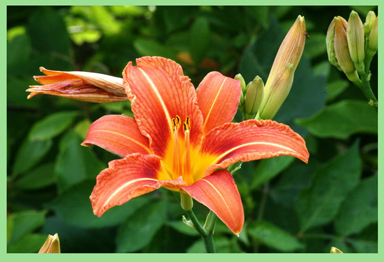
Our home was surrounded by trees and flowers – a bed of hydrangea and snowball bushes rimmed with a ruffle of pink phlox, a wisteria vine so thick I could use it as a seat, fragrant jasmine and honeysuckle outside the bedroom windows, and a long line of redbud trees down the side of the house. A huge shade tree in the front yard made a wonderful place to play, and a beautiful, thick hedge rimmed the back yard. But the one plant everyone remembered best was my grandmother’s tiger lily.Orange tiger lily flower with buds

The tiger lily bloomed each year in its special place by the back door. It was a sort of family treasure, a little piece of beauty that only the family saw. I would sit on the back steps and just bask in the glory of the soft air and the loveliness of those few perfect petals.

When we moved to a new home, my mother continued the tradition. Right under my bedroom window, if you bent down low and knew where to look, was a patch of tremulous, pink, heart-shaped blooms – a beautiful bleeding heart plant.

Hot pink tear-drop shaped bleeding heart plant blooms

Bleeding heart blossoms.

My best friend’s father was a horticulturist. At their home, in its splendid, creamy glory, was a gardenia. He took us on regular viewings (even though it was right outside the front door) and explained to us how delicate the petals were. We wouldn’t have touched one for all the money in the world. Then he would get into the more technical aspects, such as soil acidity, and our eyes would glaze over. But we got the idea – Mother Nature has all sorts of complications and demands, and we’d better respect them. We could end up living in a desert if we didn’t play by her rules.

It seemed that everyone I loved had that one special flower that defined who they were. Name a flower, and I will come back with the name of the person I associate it with. The agonizing wait for the plants to bloom and the joy of their blossoming are memories I treasure to this day. What a wonderful thing to give a child, a thing of beauty to be anticipated and then reveled in. How marvelous to have one special thing, no matter how inexpensive, to provide you with joy and beauty.

Through these stunning flowers my mother and grandmother taught me that life is a cycle. I learned the value of patience, of waiting for things of value. Never give up in the dead of winter – Spring is coming!


Text copyright 2015 by Jill Teresa Farmer

Mother’s Microwave Peach Jam

This doesn’t last as long as regular preserves, but it will probably be eaten quickly! I like to use sterilized jelly jars just on general principles. Be sure to label them for use within two weeks. If you have good peaches, you can leave out all the spices.

2 cups peeled cubed, sliced or chopped peaches (It usually takes me about 5 peaches)

3 tablespoons cane sugar (you may want to add more, depending on your peaches and your personal taste)

1 tablespoon cornstarch

1/4 teaspoon ground ginger

1/4 teaspoon ground allspice

A pinch of salt (if you want it)

1 teaspoon fresh lemon juice
 

First, get a microwave-proof quart bowl and combine the peeled and chopped peaches, sugar, cornstarch, ginger, allspice, and salt (if you’re going to use it). You want the peaches to come up no more than about a third of the way in the bowl. Microwave on high for 3 minutes without a cover. Keep an eye on it so you’ll know how your microwave cooks this recipe. You’ll be more comfortable knowing whether it might start to boil over or not.

Next, stir it well and give it another 3 or 4 minutes or until it starts to thicken. Remove it from the microwave and use a potato masher or a fork to break up any large pieces. Stir until it is the right consistency for spreading.

Add the lemon juice, stir, and set it aside until it is cooled a bit. At this point cover it and put it in the refrigerator until it thickens. It is best to leave it in overnight or at least for several hours. You can also put it in individual little jelly jars. Label so folks will know it must be used within two weeks.

This recipe gets better as you make it. You get to know just how long to cook it to your taste and just what spices you want (I sometimes use a pinch of ground cloves). Each batch will be better as you experiment.

If you find you enjoy making this recipe, just substitute whatever fruit is in season and change the spices accordingly.

Happy cooking!


Buttons – from pearl to hand crocheted

One by one, the sewing supplies my grandmother once used disappeared or became of such inferior quality that she wouldn’t use them. She had once been the seamstress of our little Southern town, and no cost-cutting measure escaped her sharp eye. She always complained that no one had “dainty” lace any more. Or soft enough cotton fabric. Then she couldn’t find eyelash cotton. Then all the dotted Swiss “got funny”. She was very particular.  “I wouldn’t waste my time sewing that up,” she’d often say. And one of her prime targets – after the quality of the fabric – was buttons.

My grandmother’s button box was filled with tiny pearl buttons, exquisitely small with minute holes that only the slimmest of needles could penetrate. When she and my mother and I would go on one of our marathon fabric shopping trips, she always went prepared.There would be her little sack of fabric swatches, sketches of what she wanted to make, all sorts of measurements and yardage notes. And her glasses were freshly washed. (“They’re not going to put anything past me!”) From the moment we hit the parking lot, she got that steely determined look that told us she was ready for the hunt.

One of grandmother's tiny pearl buttons on a baby dress she made in the 1920s. ©Jill Teresa Farmer

One of grandmother’s tiny pearl buttons on a baby dress she made in the 1920s.
©Jill Teresa Farmer

Her first target was always the notions counter. (She was always running out of those short, thin needles, her favorite tool.) She would “tsk, tsk, tsk” her way up and down the rows, and when she got to the buttons she would suddenly lean forward, squint, and adjust her glasses. “Awful, just awful,” she would proclaim. None met her standards. (Neither did ribbons, but that’s another story.)

“You have to buy buttons when you find them,” she instructed my mother and me. “You can’t wait. If you find a nice button in a basic color – buy enough to do a blouse that buttons up the front and add two for each sleeve. That’s the only way you can be sure you’ll have enough.” We filed this gem away. My grandmother’s proclamations about sewing were always right.

We rarely had “store-bought” clothes, but when something impressed one of us it inevitably had to be altered. Something was always wrong. Being short, with me it was usually adjusting the hem. A dress for my mother had to have the waist taken in. My grandmother was tall and thin, so she could usually wear anything as is, except for one thing – you guessed it, the buttons. I recall our finding a dress for my teenage self that was a real find. But of course the buttons weren’t good enough. On the way home we took the dress into a fabric store to find some of a better quality. Then we were so excited that we sat up and replaced every fastener on the dress. After that, my mother took it to her sewing machine and reinforced the sleeve seams. It didn’t seem so store-bought after all the extra time we put into it.

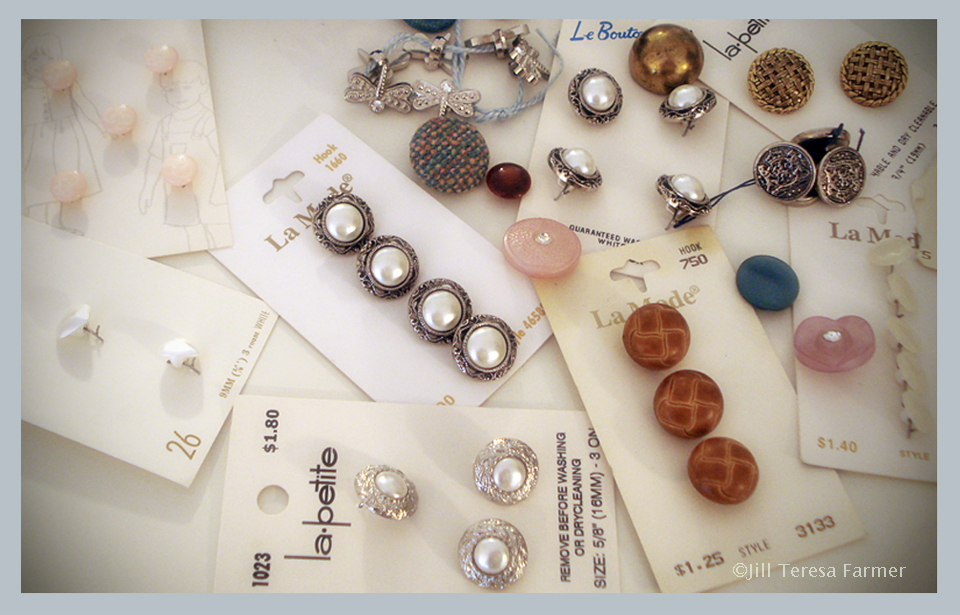
Various buttons

©Jill Teresa Farmer

Mother’s favorite designer was Coco Chanel, and she copied many of her beautiful suits. For these she bought gold dome buttons and white plastic rings. She would carefully cover the ring with coordinating fabric from the suit, nestle the gold dome inside, and sew it in firmly. Voila – Chanel-style buttons! My big love was covered buttons. To me they were the epitome of style. But the day came when they changed up the whole system and I could no longer get it right. I was blue for a week.

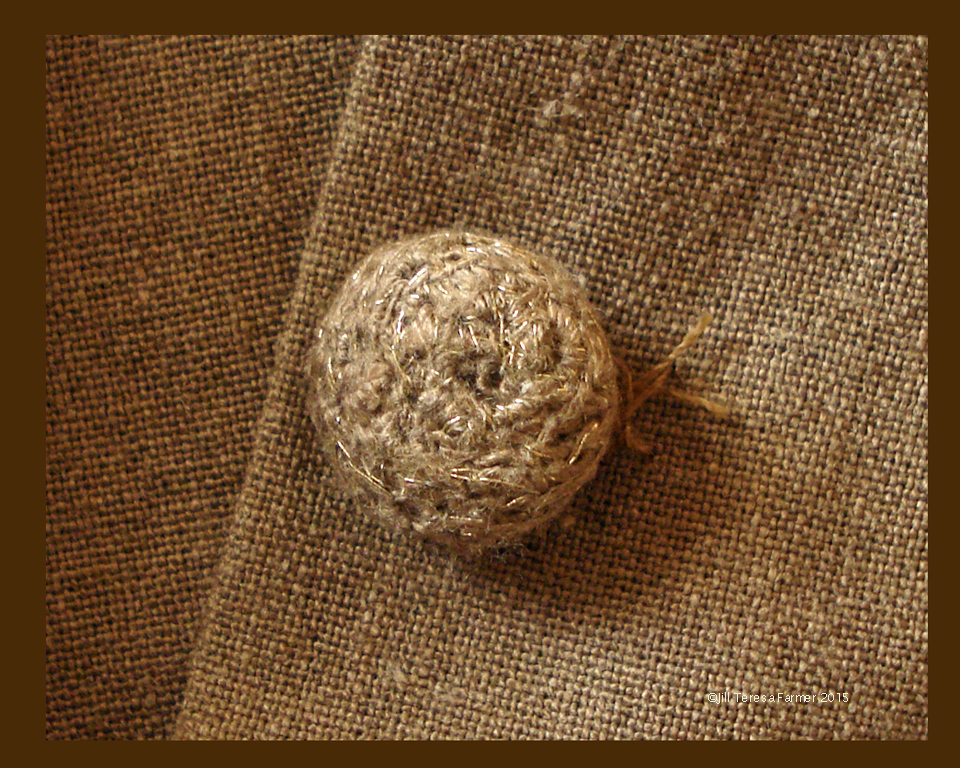
One day, after my grandmother had made her way to Heaven, my mother came to me with a beautiful linen suit she had made. “I made it, but now I can’t find any buttons to match. All of them are just so tacky.” I sympathized. She had some choices, but the elegant outfit lost some of its beauty with what she had on hand, and we knew there was nothing better at the store. The fabric had been an impulse buy because of its quality and beautiful, subtle color. But we had nothing in any of the button boxes to work with. But with an inventor for a father, I knew there was an answer to this. It took me a while. And then I hit on the answer – crocheted buttons! At first my mother was horrified. Crocheted buttons on a chic suit? But what I had in mind was a little more sophisticated than that. I got some of her scraps and unraveled the threads. Then I added one fine strand of gold thread. And with them I crocheted matching round buttons. She loved them.

Crocheted button made from fabric ravelings and gold thread

Button crocheted from unraveled threads with a strand of gold embroidery thread. I pulled the thread that holds it all together to one side so you could see its heaviness. ©Jill Teresa Farmer 2015

Looking through four generations of button boxes is a sweet trip down memory lane for me. My grandmother’s tiny pearl buttons, too rare now for me to bear using; the gold buttons in all sizes and designs; the cute little daisies with the yellow centers that we were sure we’d never use but were just too cute to pass up; the ones we cut off the men’s shirts before they became dust rags; the feminine pale blue buttons with the tiny rhinestones from a decades-old lingerie set….

Those were happy days, with my grandmother sitting on the window sill so she would have plenty of light to make her tiny hand stitches; my mother bending over the old Singer with her toolkit and oil can, overhauling the entire contraption; and me, wondering if I would ever grow up to be as talented as they were. I didn’t, but I have beautiful memories of the women in my family doing what they loved.


Copyright ©2015 Jill Teresa Farmer. All rights reserved.